Almost every complaint about creatine is a hydration problem wearing a costume. Bloating in week one. The scale up two pounds. A dry mouth, a dull headache, a session that felt flat. None of that is the creatine misbehaving — it is water being redistributed, and a body that has not been given enough of it, or enough of the minerals that hold it in place.
So this is the boring companion article to the creatine one: what the water is doing, and how to stop working against it.
Creatine pulls water in — that's the point
Creatine is stored in muscle as phosphocreatine, and it is osmotically active: where creatine goes, water follows. Muscle cells take on fluid as stores fill. That intracellular water is not a side effect to be tolerated — cell volume is part of the mechanism, and it is why the scale moves in the first week and then stops.
Powers' 2003 study in the Journal of Athletic Training measured this directly: creatine supplementation increased total body water without shifting the balance between intracellular and extracellular compartments — that is, it did not cause the subcutaneous water retention people fear. Hultman's classic 1996 work in the Journal of Applied Physiology established the loading arithmetic still in use: a large dose for a few days, or roughly 3–5 g daily, reaches the same muscle saturation in about three to four weeks.
The International Society of Sports Nutrition's 2017 position stand on creatine, and Antonio's 2021 paper on common misconceptions, both address the folklore head-on: at normal doses, in healthy people, creatine does not dehydrate you, does not cause cramping, and does not require water loading. Smith-Ryan's 2021 review in Nutrients is the one to read for women specifically — it covers the lifespan picture and the muscle, bone and cognition rationale for the perimenopause years.
What is true is smaller and more practical: creatine slightly increases your total water requirement, and if you were already running a bit dry, you will notice.
Electrolytes 101
Water alone is not hydration. Sodium, potassium, magnesium and chloride are what determine whether the water you drink stays in circulation or goes straight through you.
Sodium is the main one and the most maligned. It is the primary extracellular electrolyte and it drives fluid retention in a useful sense — it is why oral rehydration solutions contain salt and why plain water is a poor rehydrator after heavy sweating. The American College of Sports Medicine's 2007 position stand on exercise and fluid replacement is still the reference: replace fluid and sodium in proportion to what you lose, and do not drink so far ahead of losses that you dilute your blood sodium.
Sweat losses vary enormously — very roughly 200 to 1,600 mg of sodium per litre — which is why generic numbers are useless and your own experience is not. Potassium and magnesium matter for muscle and nerve function but are lost in far smaller amounts, so food covers them for most people. And hot flushes count: night sweats and flushes are real fluid losses, and they are one reason women in perimenopause can feel persistently dry despite drinking plenty.
The practical bit: 5 g of creatine daily, water across the day rather than in two big hits, and something with sodium in it on hot or hard days. That is the whole protocol.
How to pair Foundation and Flow
Read the labels before you assume you need both, because this is the part people get wrong.
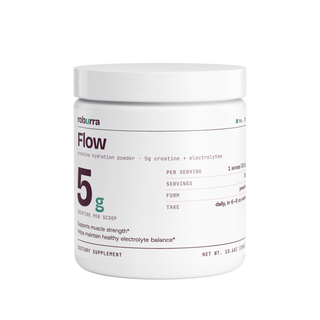
Foundation is creatine monohydrate and nothing else — one ingredient, 5 g per scoop, unflavoured, mixes into anything. Flow is a flavoured hydration powder that already contains 5,000 mg of creatine monohydrate per 10 g scoop, alongside 1,000 mg of sodium from sea salt, 200 mg of potassium and 60 mg of magnesium.
So the pairing question is really a choosing question:
- Flow on its own covers both jobs on training days, hot days, and any day you would rather drink something with a flavour. One scoop, one glass, done.
- Foundation on its own is the cheaper, cleaner everyday option if you do not need the electrolytes — stirred into coffee, tea, yoghurt or a smoothie.
- Both in one day means about 10 g of creatine. That is not dangerous, but it is above the dose the evidence supports and it is the most common source of first-week stomach complaints. If you use both, split them across the day, or treat Flow as your creatine on the days you drink it and skip the scoop of Foundation.
The simplest working rule: Flow on training and hot days, Foundation on the rest. Five grams a day, one way or the other, every day including rest days — creatine works by saturation, not by timing.
Training-day template
A template, not a prescription. Adjust to your own sweat rate and schedule.
- On waking: 300–500 ml of water. You lose fluid overnight through breathing and, if you get flushes, rather more.
- 60–90 min before training: 400–500 ml. If it is hot, or the session is long, make this the Flow scoop so the sodium goes in ahead of the sweating.
- During: sip to thirst. For sessions under an hour in a normal room, water is fine. Beyond that, or outdoors in heat, keep something with sodium in the bottle.
- After: drink to thirst plus a bit, and eat a normal meal — food carries the sodium and potassium replacement for anything short of an endurance event.
- Rest days: the creatine still happens. The extra fluid mostly does not need to.
Two checks that beat any app. Urine that is pale straw rather than clear or dark means you are roughly in range across the day — first-morning urine is always darker, so judge from mid-morning onward. And weight: if you are consistently a kilo lighter at the end of a hot training day, that is fluid, and it is worth replacing before the next session rather than the next week.
Clear urine all day is not a gold star. It usually means you are drinking past your needs and flushing sodium out with it, which is its own kind of flat.
Myths worth dropping
- "Creatine dehydrates you." The measured effect is the opposite — total body water goes up. The ISSN position stand states this plainly.
- "Creatine causes cramps." Controlled trials do not support it. Cramping tracks with sodium loss, fatigue and unfamiliar workloads.
- "It'll make me look puffy." The water goes into muscle cells, not under the skin. Powers' study found no shift toward extracellular water.
- "You need a loading phase." You do not. 5 g daily reaches the same place in three to four weeks, with fewer stomach complaints.
- "More water is always better." Drinking far beyond your losses dilutes sodium and makes you feel worse, not better.
- "Electrolyte powders are for athletes." The people who most often need the sodium are the ones sweating in a warm house at 3am.
If you have kidney disease, high blood pressure, or you are on medication that affects fluid balance or sodium, take the sodium question to your clinician before adding an electrolyte powder. Everyone else: drink to thirst, salt on hard days, 5 g daily, forever.
Does it matter what I mix creatine into?
No. Warm liquid dissolves it better, and food or drink makes no difference to saturation.
Should I take Flow on rest days?
Only if you want the flavour or the sodium. The creatine is the part that needs to be daily.
Sources
- Kreider RB, et al. “International Society of Sports Nutrition position stand: safety and efficacy of creatine supplementation in exercise, sport, and medicine.” Journal of the International Society of Sports Nutrition, 2017.
- Antonio J, et al. “Common questions and misconceptions about creatine supplementation: what does the scientific evidence really show?.” Journal of the International Society of Sports Nutrition, 2021.
- Powers ME, et al. “Creatine supplementation increases total body water without altering fluid distribution.” Journal of Athletic Training, 2003.
- Hultman E, et al. “Muscle creatine loading in men.” Journal of Applied Physiology, 1996.
- Smith-Ryan AE, et al. “Creatine supplementation in women's health: a lifespan perspective.” Nutrients, 2021.
- Sawka MN, et al. “American College of Sports Medicine position stand: exercise and fluid replacement.” Medicine & Science in Sports & Exercise, 2007.