Stiff hands in the morning. A knee that complains on the first flight of stairs and then forgets about it. Shoulders that need ten minutes before they feel like yours. This shows up for a lot of women somewhere in the mid-forties, usually without an injury to blame it on, and it is common enough to have a name in the literature: musculoskeletal pain is one of the most frequently reported symptoms of the menopause transition.
It is also one of the least discussed, which leaves a lot of women assuming the only explanation is age. There is more to it than that.
The estrogen–cartilage link
Estrogen receptors sit in cartilage, in synovial tissue, in tendon and in bone. That is not incidental — estrogen is part of how those tissues manage turnover and inflammation. Roman-Blas and colleagues laid out the mechanistic case in Arthritis Research & Therapy in 2009: when estrogen falls, cartilage metabolism and joint tissue behaviour shift with it.
Clinically, Watt's 2018 review in Post Reproductive Health is the useful summary. Joint and muscle pain is reported by a large share of women across the transition, it clusters with other symptoms, and it is frequently the symptom women mention last — behind hot flushes and sleep — despite affecting daily function more.
Two honest caveats. First, association is not the whole story: body composition, activity levels, sleep quality and pain sensitivity all change in the same window. Second, the fact that estrogen is involved does not mean a supplement can replace it. What it does mean is that stiffness arriving at 46 without an injury is a recognised pattern, not a personal failing.
What the evidence supports
Strip out the noise and the strongest finding in this whole field is unglamorous: movement is the best-evidenced intervention for joint pain, and it beats everything sold in a bottle.
Fransen's Cochrane review of exercise for knee osteoarthritis, updated in 2015, pooled dozens of randomised trials and found consistent improvements in pain and physical function, with benefit persisting for months after the programmes ended. Hunter and Bierma-Zeinstra's 2019 seminar in The Lancet reaches the same place from the clinical side: exercise, strength work and weight management are first-line, and they are under-prescribed relative to their effect size.
Notice what the evidence does not say. It does not say rest. It does not say that load wears joints out like brake pads. Cartilage has no blood supply of its own; it is fed by joint fluid moving under compression. Sensible load is how cartilage gets fed.
The practical bit: two strength sessions and a daily walk beat any supplement in this category, by a wide margin. Everything else is a rounding error on top.
Training that helps, not hurts
The mistake is not training. The mistake is bouncing between nothing and too much.
- Load the muscles around the joint. Quads and glutes for knees, upper back and rotator cuff for shoulders, grip and forearm work for hands. Stronger surrounding muscle means less peak load on the joint itself.
- Full range, moderate weight. A split squat you can control through its whole range does more for a knee than a heavy quarter-rep.
- Increase one thing at a time. Weight, reps or frequency — never all three in the same week. Most flare-ups are a jump in volume, not a wrong exercise.
- Use the 24-hour rule. Soreness that settles within a day is training. Pain that is worse the next morning, or swelling, means back off that movement and get it looked at.
- Warm up on purpose. Five to eight minutes of easy cycling or brisk walking changes how the first working set feels, especially in cold months.
Impact is not the enemy either. Brief, low-volume impact — stair climbing, skipping, hops — is well tolerated by most healthy joints and is one of the few stimuli bone responds to. Build up slowly.
Where supplements fit
Honestly? At the margins, and the evidence is mixed.
Liu's systematic review and meta-analysis in the British Journal of Sports Medicine in 2018 looked across joint supplements and found that most produced small effects, that the larger effects tended to come from smaller and lower-quality trials, and that only a handful — including curcumin and Boswellia extracts — showed short-term benefit for pain and function that survived reasonable scrutiny. Glucosamine's record is inconsistent: some trials show modest improvement, the largest and best controlled show little separation from placebo.
So the reasonable position is neither "these are magic" nor "these are useless". They are a small possible addition to a training habit that is doing the actual work.
If joint pain is severe, swollen, hot, or affecting one joint dramatically more than the others, that is a clinician's question, not a supplement's. Please treat it as one.
A realistic week
Not an athlete's programme. A week that survives a job and a family:
- Monday: 30–40 min full-body strength. Squat or split squat, a row, a press, a hinge, a carry. Two to three sets each.
- Tuesday: 25–30 min walk, ideally outdoors, plus two minutes of hand and wrist mobility if mornings are stiff.
- Wednesday: Rest, or the same walk.
- Thursday: Repeat Monday, one small increment heavier or one rep longer.
- Friday: Walk. Add two or three flights of stairs if knees are behaving.
- Weekend: One longer, enjoyable thing — a hike, a swim, a bike ride, a garden — and one genuinely idle day.
Give it eight weeks before judging it. Joint symptoms fluctuate week to week for reasons that have nothing to do with what you changed, so a single bad Tuesday is noise, not a verdict.
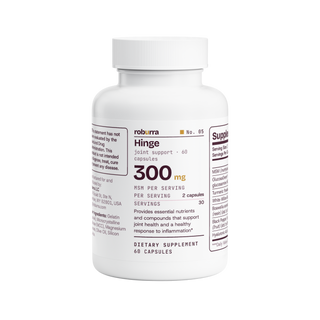
If you want a daily supplement running alongside that week, Hinge is ours: one serving a day, formulated to support joint comfort and everyday mobility. Treat it as an addition to the habit above rather than a substitute for it — the training is what does the work here.
Should I stop training when a joint aches?
Usually no — modify instead. Reduce range, reduce load, change the angle. Stop and get advice for swelling, locking, or pain that is worse the following morning.
How long before a joint supplement tells me anything?
Give it eight to twelve weeks alongside a stable training routine. Any shorter and you are reading the weather.
Sources
- Roman-Blas JA, et al. “Osteoarthritis associated with estrogen deficiency.” Arthritis Research & Therapy, 2009.
- Watt FE. “Musculoskeletal pain and menopause.” Post Reproductive Health, 2018.
- Fransen M, et al. “Exercise for osteoarthritis of the knee.” Cochrane Database of Systematic Reviews, 2015.
- Hunter DJ, Bierma-Zeinstra S. “Osteoarthritis.” The Lancet, 2019.
- Liu X, et al. “Dietary supplements for treating osteoarthritis: a systematic review and meta-analysis.” British Journal of Sports Medicine, 2018.